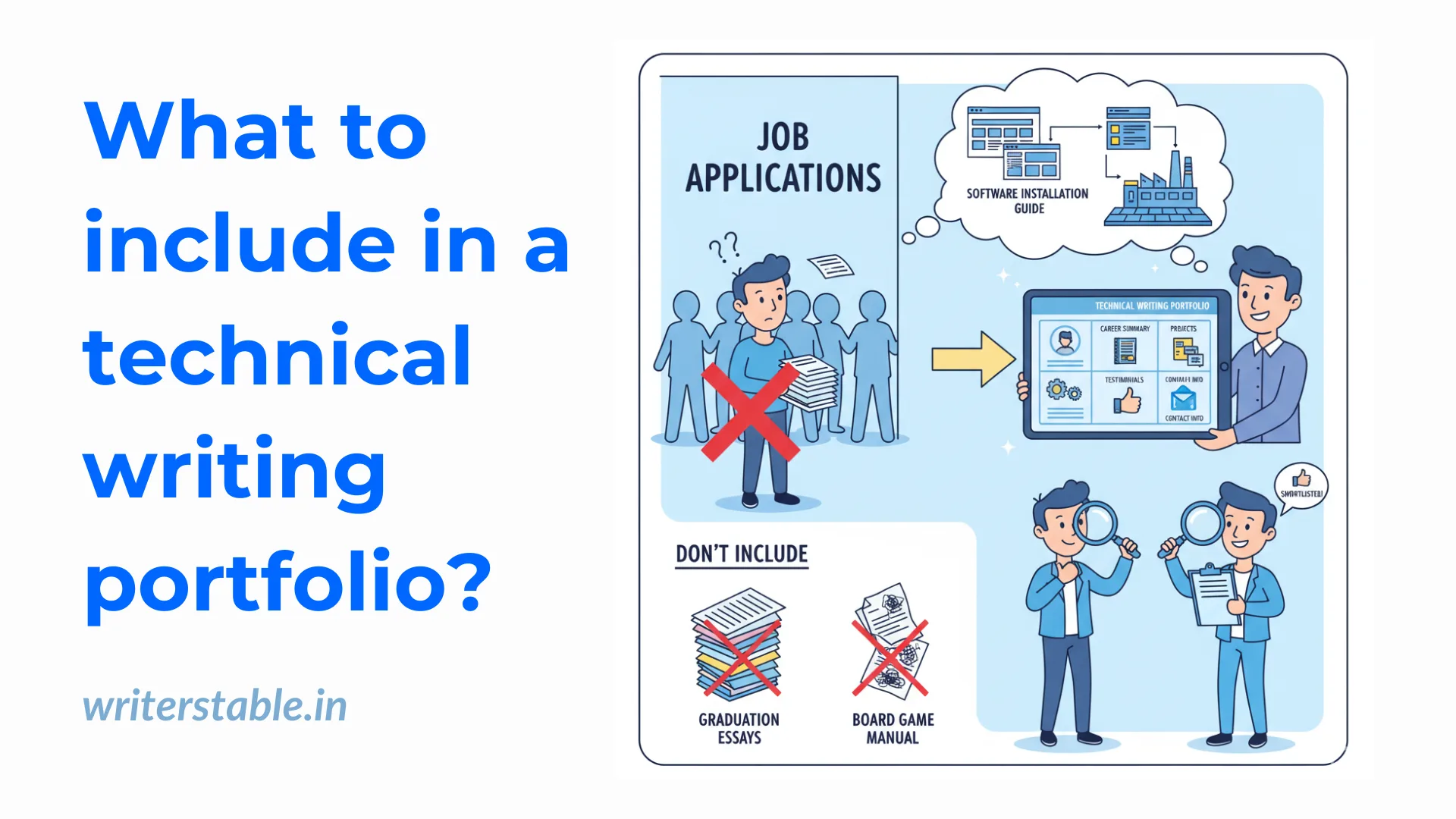
Everybody talks about the significance of having a technical writing portfolio. Very few offer practical tips and instructions about building one. In this article, I will show you what to include in a technical writing portfolio (important sections), types of content to showcase, compare online and offline portfolios, and most importantly, what not to include in a technical writing portfolio.
Table of Contents
What is a technical writing portfolio?
A technical writing portfolio is a collection of writing samples that demonstrate your abilities as a technical writer. It gives employers a glimpse of your skill set, your knowledge of technical writing tools, skills, and processes. If you’re a beginner or transitioning into technical writing, a technical writing portfolio works wonders for your profile. My article introducing technical writing portfolios dives more in detail into the classic definition of a technical writing portfolio and its significance. Be sure to check it out.
Why is a technical writing portfolio important?
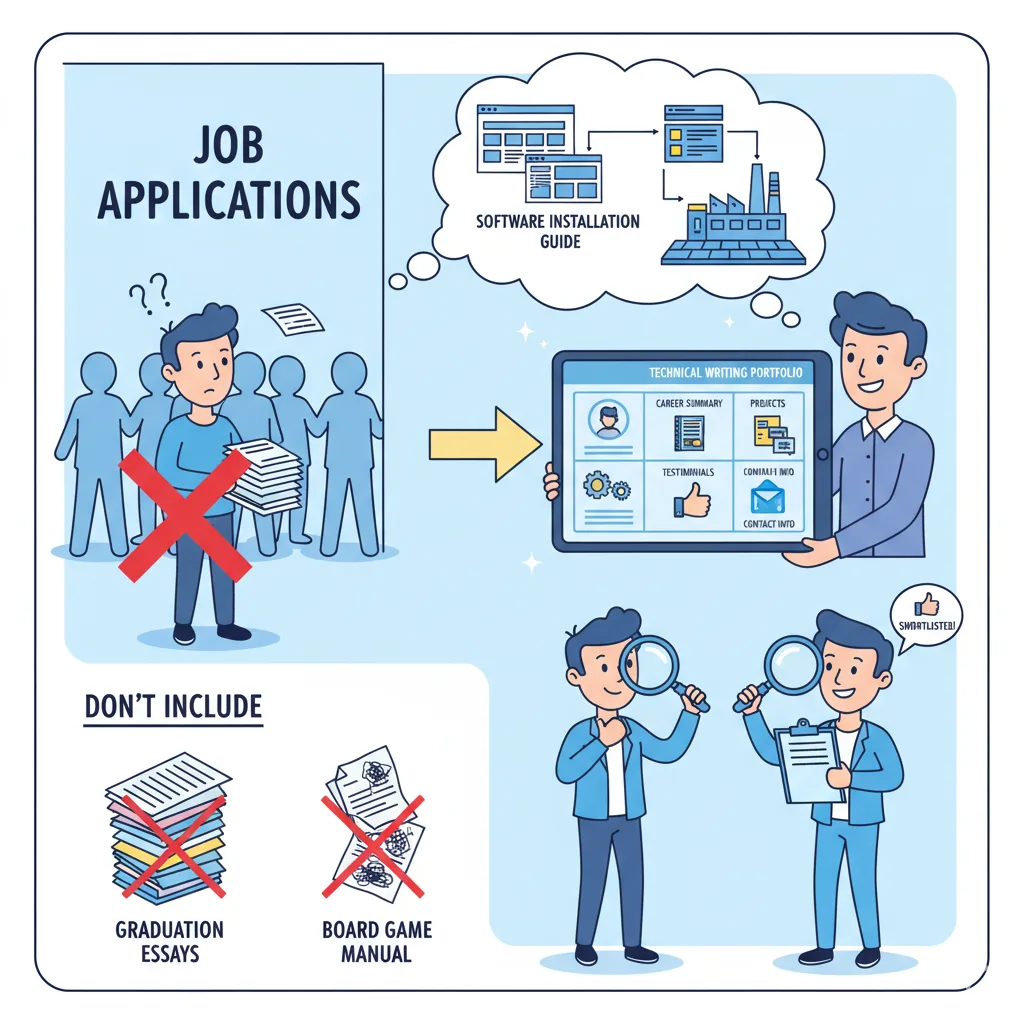
Every project or job post has hundreds of applications. Very few of these applications include samples of the applicant’s work or a well-defined technical writing portfolio. A technical writing portfolio, combined with your resume, makes it easy for recruiters and employers to shortlist you. It gives them a first impression of your writing style. Especially if you’re a beginner or transitioning into technical writing, since you lack technical writing experience, showcasing your technical writing skills with a technical writing portfolio can give you an edge over others.
What to include in a technical writing portfolio (technical writing portfolio structure)?
How to structure your technical writing portfolio? The idea is to keep it as simple as possible. There’s absolutely no need to show your web-design prowess (unless it’s a role requirement). Think as a potential recruiter. A straightforward structure goes a long way in enabling recruiters to quickly scan your portfolio.
Here’s what you must include in your technical writing portfolio:
- Career summary
- Projects
- Testimonials
- Contact information
Here’s an example technical portfolio:
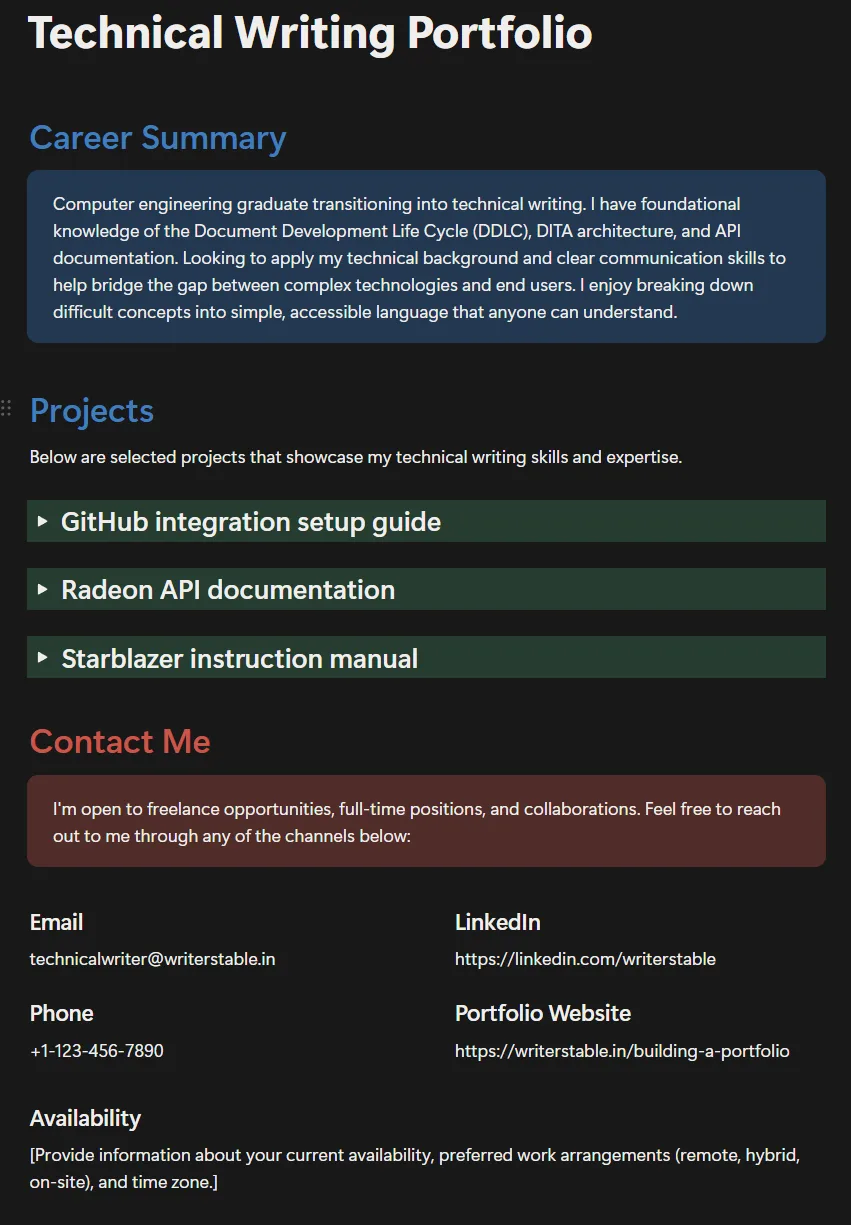
Let’s look at each of these sections in detail so you know exactly what to include in your technical writing portfolio’s different sections.
Career summary
Briefly describe your skill set that makes you a compelling choice as a technical writer. Use “About me” if you’re creating a portfolio as a beginner. Since you don’t have any experience to showcase, the portfolio will demonstrate your skills as a writer and your knowledge of the tools and processes. Experienced technical writers can give a short overview of their career and experience.
You can also mention your educational qualifications and certifications. Certain industries or sectors, like aeronautics, oil and gas, defense, and pharmaceuticals, require you to know industry and quality standards, so listing them here will help recruiters and shortlist your profile easily.
Projects
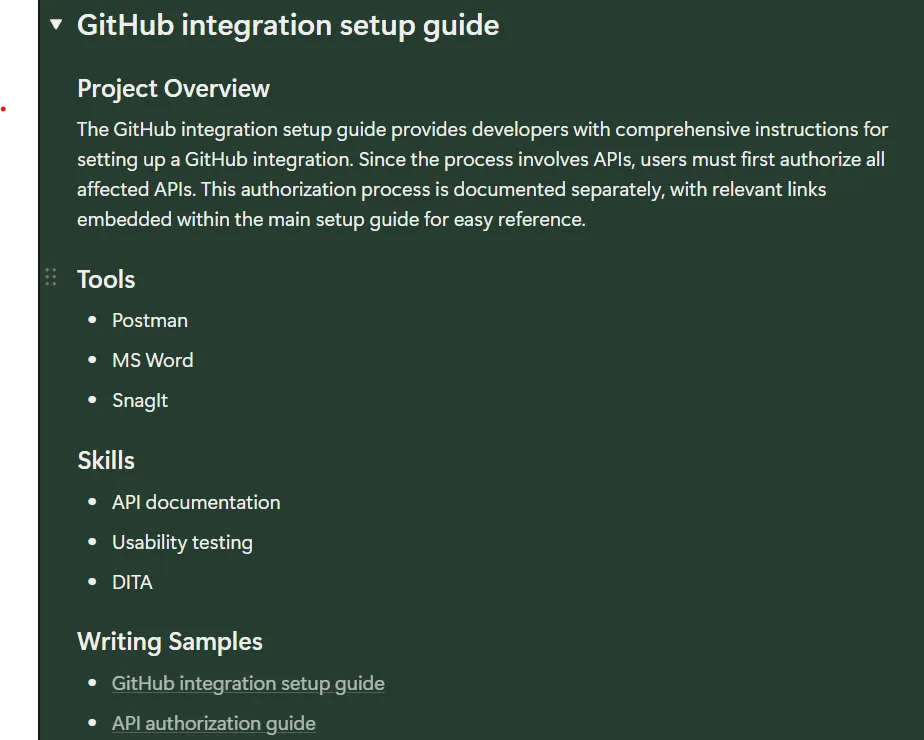
List all your writing projects, the type of documentation, project overview, skills, and tools used. Don’t lose heart if you don’t have any professional experience. You can still create work samples for different types of documentation, showcasing your expertise with tools and processes. So, the projects section must include:
- Project title
- Project overview
- Tools used
- Skills used
The project overview must talk about the project scope, intended audience, frameworks (if any, like DITA), and types of documentation created. Don’t use this section to talk about the product or feature you documented or based the work sample upon. Remember to link each project overview to the sample. For beginners, it is best to include samples of your writing within the portfolio itself as a separate chapter (or webpage) for each project. This will save your prospective client or recruiter from having to look at multiple external sources just to view your samples. Experienced writers can just link to their published docs from the overview.
The Projects section is just an overview of your projects or writing samples; you will describe all projects in detail in subsequent sections. Alternatively, if your work samples reside elsewhere, Google Drive, GitHub, etc., then add links to these samples.
Tools must include the technical documentation tools you used for each aspect of the project. This includes writing tools, editing tools, and image editing tools. Why is this necessary? Assuming your portfolio passed the ATS check, recruiters will just skim your portfolio and catch keywords. Listing tools individually will let them know your expertise and knowledge.
Example project in technical writing portfolio
Testimonials
List a few testimonials from your existing or previous clients. This section is optional for beginners. Don’t fill it with fake fluff; that will almost immediately get you disqualified. Experienced technical writers can include feedback from their managers and stakeholders.
Contact information
Leave a link to your LinkedIn profile and an official-sounding email ID (no prettyboy123@abc.com, please!) I would not include a phone number; it leaves you more open to spam/phishing calls than useful calls or notifications. If your portfolio is a webpage, include a contact form.
Types of projects or samples to show in your technical writing portfolio
Now that we have the basic structure of a technical writing portfolio, which projects or work samples do you include in your technical writing portfolio?
This can vary based on the types of technical writing you’re interested in. For example, if you’re pursuing a career in software technical writing, you can include installation guides, troubleshooting guides, and samples of API documentation. Likewise, if you are interested in being a technical writer in the manufacturing sector, your samples can include assembly instructions for a product or a maintenance and repair guide. For a career in medical technical writing, samples can include white papers, case studies, or detailed engineering specifications.
Regardless of the type of technical writing you pursue, the samples in your technical writing portfolio must highlight your ability to:
- Convey information clearly
- Use a consistent style
- Use concepts like DDLC (Analysis > Design > Develop > Review > Maintain)
- Use structured authoring (DITA framework). If you don’t have any experience with DITA, that is okay, too.
Project samples for those with no experience or blocked by confidentiality agreements (NDAs)
You can draw inspiration from various aspects of your daily life and studies. Consider creating:
- Tutorials on tasks you’ve done in real life. For example, connecting a router, setting up a VPN.
- Documentation for processes you commonly use.
- Guides for hobbies where you need to set something up or perform actions in a specific order.
- Reference sheets for specific information required for a certain task (or hobby).
- For the more mechanically inclined, an assembly guide using only images.
Online vs offline technical writing portfolio
Should your technical writing portfolio be available online as a webpage? Should it be a simple PDF or Word document?
I prefer an online portfolio because it is easier to maintain. Just update your portfolio as your experience expands, and anybody with a link to the portfolio will have access to your latest experience. More importantly, it is easier to fix if you spot any mistakes in the portfolio after publishing it. Imagine sharing an offline portfolio along with a job application, only to realise that there was a typo!
On the other hand, having an offline portfolio, probably a simple Word or PDF, is easier to create if you aren’t comfortable with tools like WordPress, Blogger, Google Sites, or any free tool for creating a website or a webpage. You can also prefer an offline portfolio if you don’t like having your portfolio available publicly. Having an offline portfolio is also better if you have multiple portfolios. It’s always best to keep portfolios specific to the role you’re targeting.
Recruiter’s preference also matters here, I think. Some prefer an online portfolio, others an offline version. In such cases, keeping an online portfolio makes sharing updated portfolios easier as and when needed.
What not to include in a technical writing portfolio?
Now that we have established what to include in your technical writing portfolio, let’s look at stuff to absolutely, irrevocably, and comprehensively avoid!
Graduation essays
This is especially for beginners. Granted that you don’t have professional experience, but that doesn’t mean your college essay on global warming can be cited here. Unless, of course, your college project or assignments were related to the field of technical writing you want to pursue.
General instruction manuals for everyday tasks
While some sources suggest starting with simple guides like “a cooking recipe, how to change a tire, how to tie your shoe”, recruiters and hiring managers don’t take those samples seriously. The implication is that if such samples are included, they need to demonstrate strong technical writing principles, or it’s better to focus on more complex or technically oriented topics, like an app or a wireless router. By the way, this also includes board game instruction manuals!
Low quality content (quality over quantity)
Hiring managers are less concerned with the sheer volume of pages (e.g., “60 pages”) and more with the high quality of the pages presented. Including many mediocre pieces is less effective than a few strong, polished examples.
Samples without process or context
Hiring managers highly value understanding the candidate’s process and thought behind their work. Simply presenting a finished document without explaining the approach, anticipated obstacles, how content was sent for review, or how revisions were handled may make the portfolio less impactful.
Content without proof of authorship
If contributing to open-source projects, it’s important to ensure there’s a way to prove the work is yours, such as through documentation attribution or Git commits. Without this, the work might not be credibly attributed to you.
Incorrectly formatted technical documentation
While there isn’t one “magic” or “perfect” format for technical documentation, there are “definitely incorrect ones”. It’s crucial to present work in formats that align with industry expectations (e.g., API docs, tutorials, reference docs) rather than inappropriate structures.
Content with “writing skill” errors
Samples that contain “grammar and punctuation” errors or are not “well thought out” are detrimental to a portfolio, as hiring teams prioritise clear, error-free writing.
Using AI for your technical writing portfolio
AI won’t build your portfolio for you, the samples and the experience behind them have to be yours. But if you already know how AI fits into technical writing, you’ll recognize that it earns its place in the tasks that don’t require your judgment: figuring out which sections to prioritize, writing sharp project descriptions, and auditing your portfolio before a real recruiter does. Here are a few ways in which you can use an AI tool like Claude or ChatGPT to structure and improve and optimize your technical writing portfolio.
Note:
- The prompts below are built on the same principles covered in the prompt engineering guide for technical writers, each one follows a structured format, so you get consistent, usable output rather than a generic response.
- Replace the content enclosed within [ ] with the relevant information before running the prompt.
- The “Reference data” element in the prompt guides the AI to use a strict data source to respond to your instructions, instead of using its trained knowledge; helps avoid hallucinations, bias, and AI drift. Don’t sweat it if you don’t have reference data, you can search through job sites, or publicly available portfolios for relevant examples.
Use AI to decide which sections and samples to prioritize
As a beginner, you might overthink this and either pad your portfolio with weak samples or leave out content that would actually help you get shortlisted. Use AI to analyze your background, the roles you’re targeting, and tell you exactly what to lead with (before you spend hours building the wrong things).
Role: You're a technical writing career advisor.

Goal: Help me decide which portfolio sections and sample types to prioritize before I start building.

Context: I am a [beginner / career transition-er / experienced writer] targeting [target role] in [target industry].

Core instruction: Analyze my background against the target role. Recommend which portfolio sections to lead with, which documentation types to showcase, and what skills and tools to highlight in my career summary. Flag any gaps I should address.

Reference data: [Paste 2-3 job postings for your target role here]

Constraint: Only recommend what is relevant to the target role. Do not suggest padding the portfolio with weak or unrelated samples.

Expected output: A prioritized list of recommended sections and sample types, with a one-sentence reason for each. Follow with a short gap analysis of what is missing from my background.
Use the output as a planning checklist before you start building. Cross-reference it against real job postings in your target area to confirm the recommendations hold.
Use AI to write your project overview descriptions
The Projects section is the hardest to write well. Most writers either over-explain the product they documented or under-explain their process. Use AI to take your raw project notes and turn them into a sharp, recruiter-friendly overview that keeps the focus where it belongs: scope, audience, and what you actually did.
Role: You are a technical writing portfolio editor.

Goal: Write a project overview for the Projects section of my portfolio.

Context: Recruiters skim the Projects section to assess scope, audience, process, and tools — not the product itself. This overview will sit alongside a link to the actual sample.

Core instruction: Write a project overview using the details I provide below.

Reference data:
- Project type: [e.g., user guide, API reference, troubleshooting guide]
- Product or system documented: [brief description]
- Intended audience: [e.g., developers, end users, field technicians]
- My role and responsibilities: [what you actually did]
- Tools used: [list them]
- Skills applied: [e.g., audience analysis, DITA, stakeholder reviews]
- Challenges or constraints: [optional]

Constraint: Do not describe the product in detail. Focus on scope, audience, and my process. Use active voice throughout.

Expected output: A 3-4 sentence project overview, followed by a bulleted list of tools used and skills applied.
Paste the output into your Projects section and adjust the tone to match the rest of your portfolio. In Claude or ChatGPT, follow up with “shorten to 2 sentences” or “shift emphasis to the tools I used” if the balance feels off.
Use AI to audit your portfolio for weaknesses
This is the use case most writers skip entirely. Handing your full portfolio text to an AI and asking it to act as a hiring manager gives you a simulation of the skim-read most recruiters actually do, catching weak descriptions, missing keywords, and generic phrasing before a real recruiter does.
You are a hiring manager reviewing applications for a technical writing role.

Goal: Identify weaknesses in my technical writing portfolio before I submit it for roles.

Context: I am targeting [target role] in [target industry]. I want honest, critical feedback — not encouragement.

Core instruction: Review my portfolio text and identify anything that would cause you to rank it lower or pass on my application.

Reference data: [Paste your full portfolio text here]

Constraint: Do not rewrite any section. Identify problems only. Be direct and specific — vague feedback is not useful.

Expected output: A numbered list of issues grouped into three categories:(1) structural or content gaps, (2) weak or vague phrasing, (3) missing keywords or tools that a recruiter for this role would expect to see.
Work through the feedback in order of severity — structural gaps first, then phrasing. Run the audit again after making changes to confirm the issues are resolved. Claude tends to give more editorial feedback; ChatGPT with GPT-4o tends to be more ATS-focused. Both are worth running.
Use AI to research keywords from real job postings
Your portfolio lives or dies on whether it contains the language recruiters are scanning for, and that language shifts by industry and seniority level. Instead of guessing, feed AI a batch of job postings and have it extract the patterns, so you know exactly what vocabulary to build into your career summary and project descriptions.
You are a technical writing hiring specialist and keyword analyst.

Goal: Extract the keywords, tools, and terminology I should include in my technical writing portfolio.

Context: I am targeting [target role] in [target industry]. I want to make sure my portfolio reflects the actual language used in job postings for this role.

Core instruction: Analyze the job postings I provide and identify the patterns I should reflect in my portfolio.

Reference data: [Paste 3-5 job postings for your target role here]

Constraint: Only extract terms that appear across multiple postings. Do not include one-off requirements that reflect a single employer's preference.

Expected output: Four lists — (1) tools and platforms mentioned most often, (2) skills and processes that appear frequently, (3) industry-specific terminology I should use, (4) anything appearing in most postings that I must make visible in my career summary.
Build a keyword checklist from the output and run your portfolio text against it before submitting for any role. Revisit it every few months, tool-related expectations in technical writing shift faster than most people expect.
TLDR: Technical writing portfolio structure (conclusion)
Although I would love for you to read this article in full, if you’re hard-pressed for time, or if this is the 30th blog post you’ve read about technical writing portfolios, here’s a gist:
- A technical writing portfolio is a collection of samples that showcase your skills as a technical writer.
- Beginners or those transitioning into technical writing can significantly boost their profiles using a technical writing portfolio.
- A technical writing portfolio highlights your ability to create concise, clear, and effective documentation.
- Tailor your technical writing portfolio to the specific type of technical writing you’re interested in.
- Technical writing portfolio structure (what to include in a technical writing portfolio):
- Career summary (or About me, if you’re a beginner)
- Projects
- Testimonials
- Contact information
- Career summary section: Briefly describe your professional experience and skills. Beginners can use this section to describe their qualifications, knowledge of tools, and processes.
- Projects section: List your writing projects. This is the heart of your technical writing portfolio. Showcase all documentation types you can create. Each project must be its own subsection. With each project, list the skills, processes, and tools used.
Each project listing must provide an overview of the project scope, audience, and documentation type.- Examples of skills: audience analysis, stakeholder management, requirement gathering, research, and user testing
- Examples of tools: Camtasia, MS Office, and Oxygen XML
- Examples of processes: DDLC (Document Development Lifecycle), Agile, and DITA
- Testimonials section: Include praise and commendations from your existing or previous clients, bosses, and teammates. This is an optional section, so don’t sweat it if you don’t have any.
- Contact information section: Include a formal email address (not the one you created at 16), link to your LinkedIn profile, and optionally, your mobile phone number.
- Technical writing portfolio format: Online portfolios are easier to maintain and share. Offline portfolios are better if you keep different portfolios for different roles.
- No experience? No problem: To create a technical writing portfolio without experience, create sample documentation for products you use.
- Use AI to enhance your technical writing portfolio. Use structured prompts in an AI tool like ChatGPT, Gemini, or Claude for:
- Identifying sections and samples to prioritize based on your experience and target role; use 2 to 3 job postings as reference in your prompt for accurate recommendations.
- Tailoring project overview descriptions based on the project type, your role, audience, and tools to focus on your process and not the product you documented.
- Auditing your portfolio for weaknesses; ask AI to act as a hiring manager and identify vague language, structural gaps, and missing keywords.
- Researching keywords from job postings; use 3 – 5 job postings as reference in your prompt to identify tools, skills, and terminology that occurs frequently.
- Always verify AI recommendations before using them; AI provides the starting point, not the final answer.
Recommended reading
If you’re a beginner or considering transitioning into technical writing, here are a few articles that can simplify your journey into the world of technical writing:
- How to learn technical writing yourself?
- Technical Writing Career FAQs for Beginners
- DDLC phases in technical writing explained
- AI in technical writing
- Prompt engineering for technical writers
- Reddit: Technical writing portfolio ideas
- Reddit: Technical writing portfolio discussion
FAQs about what to include in a technical writing portfolio
Is it acceptable to include “mock content” or fictional samples in a technical writing portfolio, especially if real work is confidential?
Yes, it is highly acceptable and often recommended to create a portfolio with diverse mock content. This approach allows you to demonstrate your thought processes and communication skills, even when professional work is restricted due to privacy reasons. It is crucial to add clear labels explicitly stating that everything is “fake” or “mock,” and to use obviously fictional titles (e.g., “Mock Configuration Guide”). Following each mock sample, you can include a summary explaining your approach, anticipated obstacles, and other relevant details.
What do hiring managers specifically prioritise when reviewing portfolios for junior or entry-level technical writing positions?
For junior or entry-level roles, hiring managers tend to prioritise the quality of writing over the specific topic. They primarily look for writing that is well-thought-out and contains minimal to no “writing skill” errors, such as grammar and punctuation mistakes. After these fundamental aspects are satisfactory, the actual topic of the sample is considered. While the topic is secondary, having samples relevant to the industry you are applying to is still considered a plus.
In addition to user guides, troubleshooting guides, and glossaries, what other document types are beneficial to include in a technical writing portfolio?
While user guides, troubleshooting guides, and glossaries are valuable, a good starting point for a portfolio could also include a tutorial document (detailing steps to do something), a reference document (providing information about something), and a technical blog-style document (an article about a specific technical topic). A technical blog offers a different format to showcase your ability to explain concepts in a more discursive manner.
How credible are technical writing certifications, and can they help individuals break into the field without experience?
While not necessary, certifications and courses can help you learn the basics of technical writing. Additionally, the assignments and projects you complete as part of the certification or course can also double back as usable samples in your technical writing portfolio.
Can I use AI to build my technical writing portfolio from scratch?
AI can help you plan and structure a technical writing portfolio from scratch, but it cannot build one for you. The writing samples in your portfolio have to be your own work, they are what employers are actually evaluating. Where AI adds genuine value is in deciding which sections to prioritize, writing sharp project overview descriptions, and auditing the finished portfolio for gaps before you submit it. Use it as a planning and editing layer, not as a replacement for the work itself.
What is the best AI prompt for improving a technical writing portfolio?
The most effective prompt for improving a technical writing portfolio asks AI to act as a hiring manager and review your portfolio text for three specific things: structural or content gaps, weak or vague phrasing, and missing keywords that a recruiter for your target role would expect to see. Paste your full portfolio text into Claude or ChatGPT, name your target role and industry, and instruct it to be direct rather than encouraging. Run the audit again after making changes to confirm the issues are resolved.
I hope you found this article helpful. If you didn’t, then I would love to hear from you about what I can do to improve it. For more technical writing-related articles and resources, see the Technical Writing page. Also consider following my YouTube channel learntechnicalwriting, Reddit community r/learntechnicalwriting and Quora space Technical Writer | Technical Writing for more such content.